TABLE OF CONTENTS
What Does the Law of Diminishing Marginal Utility Explain?
By
Updated May 30, 2023
Reviewed by
Fact checked by
The law of diminishing marginal utility explains that as a person consumes an item or a product, the satisfaction or utility they derive from the product wanes as they consume more and more of that product. For example, an individual might buy a certain type of chocolate for a while. Soon, they may buy less and choose another type of chocolate or buy cookies instead because the satisfaction they were initially getting from the chocolate is diminishing.
In economics, the law of diminishing marginal utility states that the marginal utility of a good or service declines as more of it is consumed by an individual. Economic actors receive less and less satisfaction from consuming incremental amounts of a good.
KEY TAKEAWAYS
- The law of diminishing marginal utility explains that as a person consumes more of an item or product, the satisfaction (utility) they derive from the product wanes.
- Demand curves are downward sloping in microeconomic models since each additional unit of a good or service is put toward a less valuable use.
- Salespeople often use different methodologies of soliciting sales as different customers have different reasons for buying a single quantity of an item.
- Marketers use the law of diminishing marginal utility because they want to keep marginal utility high for products that they sell.
- There are several laws of diminishing marginal units, each of which is different but tangentially related across the life cycle of a product.
0 seconds of 1 minute, 28 seconds
Law Of Diminishing Marginal Utility
null
Understanding the Law of Diminishing Marginal Utility
Whenever an individual interacts or consumes an economic good, that individual acts in a way that demonstrates the order in which they value the use of that good. Thus, the first unit that is consumed satisfies the consumer’s greatest need. The second unit results in a lesser amount of satisfaction, and so on.
null
For example, consider an individual on a deserted island who finds a case of bottled water that washes ashore. That person might drink the first bottle indicating that satisfying their thirst was the most important use of the water. The individual might bathe themselves with the second bottle, or they might decide to save it for later.
If they save it for later, this indicates that the person values the future use of the water more than bathing today, but still less than the immediate quenching of their thirst. This is called ordinal time preference. This concept helps explain savings and investing versus current consumption and spending.
The example above also helps to explain why demand curves are downward sloping in microeconomic models since each additional unit of a good or service is put toward a less valuable use.
Consumption of a good often begins with an increasing marginal utility for every good consumed followed by decreasing marginal utility for later units consumed.
Diminishing Marginal Utility Examples
The law of diminishing marginal utility is not specific to any industry. Its broad concept relates to different sector in different ways. In general, it is statistically proved that consumers exert more caution and attention when faced with higher utility propositions.1 Here are some ways diminishing marginal utility influences processes along a business process.
Sales
The technique of selling goods dramatically changes depending on the consumer’s current marginal utility potential. Consider a salesperson who is selling you your first cellphone. With your marginal utility very high with any working cellphone, the sale is easy. However, if you already own a cellphone, the tactics used by the salesperson (e.g., suggesting a different phone for work, suggesting a backup phone, suggesting upgrading your existing model) will differ.
Though not directly linked to the saying “read the room,” the concept of diminishing marginal utility is very relatable, as not every client will associate the same utility with a given product. When offered a single free peanut-butter-and-jelly sandwich, for example, some consumers (including those allergic to peanut butter) may have negative utility while most people will have positive marginal utility .
Manufacturing/Inventory Management
Companies must be mindful of the law of diminishing marginal utility when planning future production schedules. They can’t always rely on historical manufacturing levels, as changes in consumer demand will impact the number of goods needed.
This concept is especially important for companies that carry inventory. The law of diminishing marginal utility can produce a very steep drop-off. Again, consider the use of cellphones. Many people only need one; there is an incredibly large jump in utility from owning zero cellphones to owning one cellphone. Should a market become quickly saturated with people who all own cellphones, a company may be stuck holding inventory.
Marketing
Marketers use the law of diminishing marginal utility because they want to keep marginal utility high for the products that they sell. A product is consumed because it provides satisfaction, but too much of a product might mean that the marginal utility reaches zero because consumers have had enough of a product and are satiated. Of course, marginal utility depends on the consumer and the product being consumed.
This is an important concept for companies that have a diverse product mix. Imagine your favorite coffee shop. If the shop only marketed a single product, consumers would likely grow tired of that product; its marginal utility would diminish. Marketing professionals must juggle piquing demand for a variety of products to keep consumers interested in numerous products.
Some units may have zero marginal utility for the second unit consumed. For example, if you already own a copy of a magazine, there’s very little to no utility in owning a second copy. In these situations, the marginal utility has decreased 100% between units.
Diminishing Marginal Utility vs. Other Measurements
The law of diminishing marginal utility should not be confused with other laws of diminishing marginal units:
- Diminishing marginal utility focuses on the consumer aspect and the decreasing nature of demand over time.
- Diminishing marginal productivity focuses on the manufacturing aspect and the decreasing nature of production over time.2
- Diminishing marginal return focuses on the merchant aspect and the decreasing nature of profits over time.
The law of diminishing marginal productivity states that the efficiency gained on slight process improvements may yield incremental benefits for additional units manufactured. An example of diminishing marginal product is labor costs to manufacture a car. It is more profitable to lay off 10% of the manufacturing staff, and the manufacturing line may make do with the remaining resources for the first few vehicles. However, after a while, the marginal manufacturing benefit decreases due to staff shortages.
The law of diminishing marginal revenue states that once maximum efficiency is reached, the amount of profit earned per unit will decrease. This can be due to a saturated nature of demand (i.e., diminishing marginal utility for consumers) or escalating production costs (i.e., diminishing marginal product for production).
Though all three laws are different, each carries with it concepts of economies of scale and is interrelated in the scope of the entire life cycle of a product.
What Is Meant By Marginal Utility?
Marginal utility is the benefit a consumer receives by consuming one additional unit. The benefit you receive for consuming every additional unit will be different, and the law of diminishing marginal utility states the benefit will eventually begin to decrease. The first slice of pizza you eat may be delicious, but the 15th slice may be a little painful.
What Is the Importance of the Law of Diminishing Marginal Utility?
The law of diminishing marginal utility dictates many aspects of how a company operates. A company must adjust how many goods it carries in inventory, as well as its sales tactics, because of the law. In addition, a company’s marketing strategy often revolves around balancing the marginal utility across product lines.
Can Marginal Utility Be Zero?
Yes, marginal utility not only can be zero but it can drop to below zero. Consider a summer barbeque. If you haven’t had breakfast yet, that first hot dog will be delicious and the second one won’t be bad either. After a while, you’ll become averse to eating hot dogs and may even get sick (have negative utility) if you continue to eat more.
The Bottom Line
There are exceptions to the law of diminishing marginal utility. For example, the law does not hold true in the case of collectors, who might be equally excited (or even more so) about buying their tenth rare coin as their first. Still, the law of diminishing marginal utility helps explain why consumers are generally less and less satisfied with each additional product.
SPONSORED
Trade on the Go. Anywhere, Anytime
One of the world’s largest crypto-asset exchanges is ready for you. Enjoy competitive fees and dedicated customer support while trading securely. You’ll also have access to Binance tools that make it easier than ever to view your trade history, manage auto-investments, view price charts, and make conversions with zero fees. Make an account for free and join millions of traders and investors on the global crypto market.
null
ARTICLE SOURCES
PART OF
Practical Look At Microeconomics
- Guide to Microeconomics1 of 40
- What kinds of topics does microeconomics cover?2 of 40
- Economists’ Assumptions in Their Economic Models3 of 40
- 5 Nobel Prize-Winning Economic Theories You Should Know About4 of 40
- Positive vs. Normative Economics: What’s the Difference?5 of 40
- 5 Factors That Influence Competition in Microeconomics6 of 40
- How Does Government Policy Impact Microeconomics?7 of 40
- Microeconomics vs. Macroeconomics: What’s the Difference?8 of 40
- How Do I Differentiate Between Micro and Macro Economics?9 of 40
- Microeconomics vs. Macroeconomics Investments10 of 40
- Introduction to Supply and Demand11 of 40
- Is Demand or Supply More Important to the Economy?12 of 40
- Demand: How It Works Plus Economic Determinants and the Demand Curve13 of 40
- What Is the Law of Demand in Economics, and How Does It Work?14 of 40
- Demand Curves: What Are They, Types, and Example15 of 40
- Supply16 of 40
- The Law of Supply Explained, With the Curve, Types, and Examples17 of 40
- Supply Curve Definition: How it Works with Example18 of 40
- Elasticity: What It Means in Economics, Formula, and Examples19 of 40
- Price Elasticity of Demand Meaning, Types, and Factors That Impact It20 of 40
- Elasticity vs. Inelasticity of Demand: What’s the Difference?21 of 40
- What Is Inelastic? Definition, Calculation, and Examples of Goods22 of 40
- Which Factors Are Important in Determining the Demand Elasticity of a Good?23 of 40
- What Factors Influence a Change in Demand Elasticity?24 of 40
- Utility in Economics Explained: Types and Measurement25 of 40
- Utility in Microeconomics: Origins and Types26 of 40
- Utility Function Definition, Example, and Calculation27 of 40
- Definition of Total Utility in Economics, With Example28 of 40
- Marginal Utilities: Definition, Types, Examples, and History29 of 40
- What Is the Law of Diminishing Marginal Utility? With Example30 of 40
- What Does the Law of Diminishing Marginal Utility Explain?31 of 40
- Economic Equilibrium32 of 40
- What Is the Income Effect? Its Meaning and Example33 of 40
- Indifference Curves in Economics: What Do They Explain?34 of 40
- Consumer Surplus Definition, Measurement, and Example35 of 40
- What Is Comparative Advantage?36 of 40
- What Are Economies of Scale?37 of 40
- Perfect Competition: Examples and How It Works38 of 40
- What Is the Invisible Hand in Economics?39 of 40
- Market Failure: What It Is in Economics, Common Types, and Causes40 of 40
Related Articles
GUIDE TO MICROECONOMICSMarginal Benefit vs. Marginal Cost: What’s the Difference?
GUIDE TO MICROECONOMICSMarginal Utility vs. Marginal Benefit: What’s the Difference?
ECONOMICSUtility Function Definition, Example, and Calculation
GUIDE TO MICROECONOMICSWhat Marginal Utility Says About Consumer Choice
MACROECONOMICSHow to Measure Utility in Economics
ECONOMICSWhat Is the Marginal Utility of Income?
Related Terms
What Is the Law of Diminishing Marginal Utility? With Example
The law of diminishing marginal utility states that as consumption increases, the marginal utility derived from each additional unit declines. Learn more.
What Is a Marginal Benefit in Economics, and How Does It Work?
A marginal benefit is the added satisfaction or utility a consumer enjoys from an additional unit of a good or service.
Marginal Utilities: Definition, Types, Examples, and History
Marginal utility is the additional satisfaction a consumer gets from having one more unit of a good or service.
Definition of Total Utility in Economics, With Example
Total utility is the aggregate summation of satisfaction or fulfillment that a consumer receives through the consumption of goods or services.
What Is the Law of Demand in Economics, and How Does It Work?
The law of demand states that quantity purchased varies inversely with price. In other words, the higher the price, the lower the quantity demanded.
Utility in Economics Explained: Types and Measurement
Utility is an economic term referring to the satisfaction received from consuming a good or service.
Investopedia is part of the Dotdash Meredith publishing family.
Please review our updated Terms of Service.
Ad
nullabout:blank
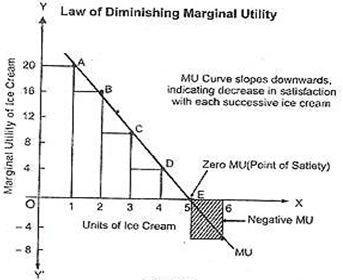
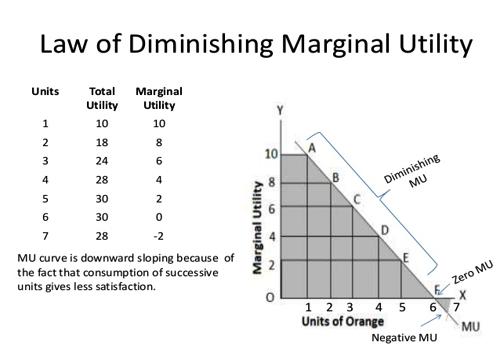
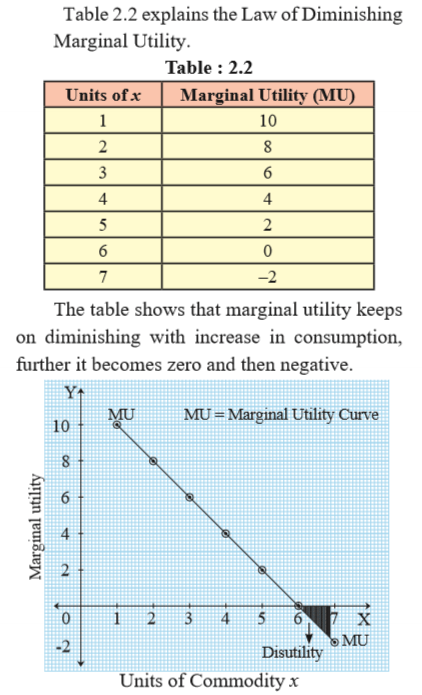
Diminishing marginal utility refers to the phenomenon that each additional unit of gain leads to an ever-smaller increase in subjective value. For example, three bites of candy are better than two bites, but the twentieth bite does not add much to the experience beyond the nineteenth (and could even make it worse).
 BIBEK
BIBEK 
Hy
LikeLike