 Formula
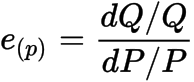
e_{(p)}=\frac{dQ/Q}{dP/P}
https://youtube.com/@Bibekkumarsahu12?si=EGLTAuSfGYJzziWG
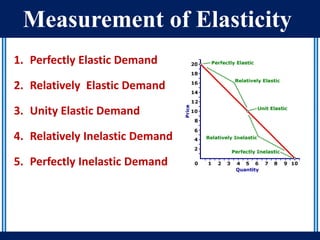
How Is Elasticity Measured?
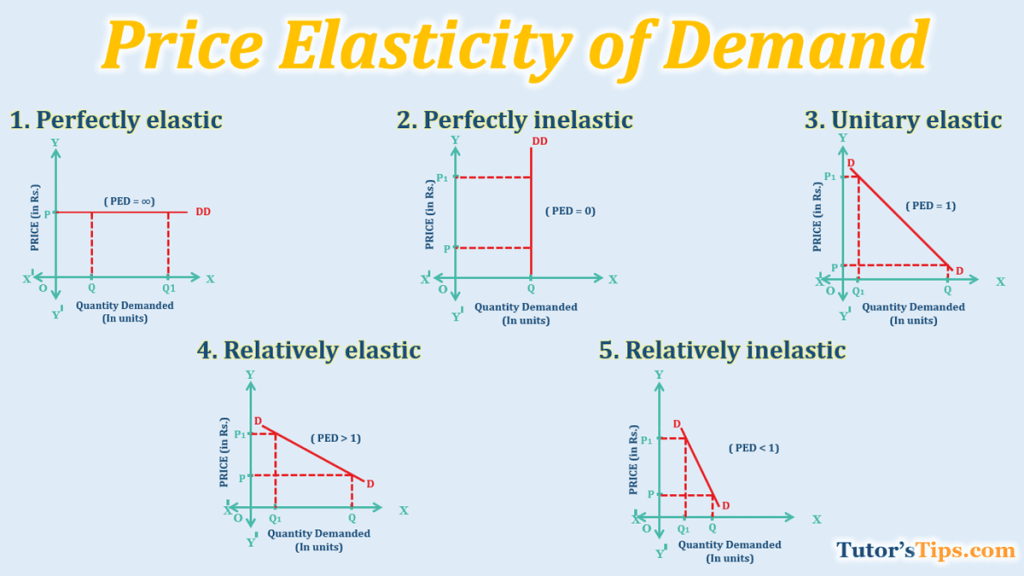
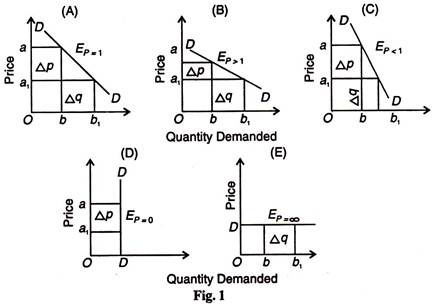
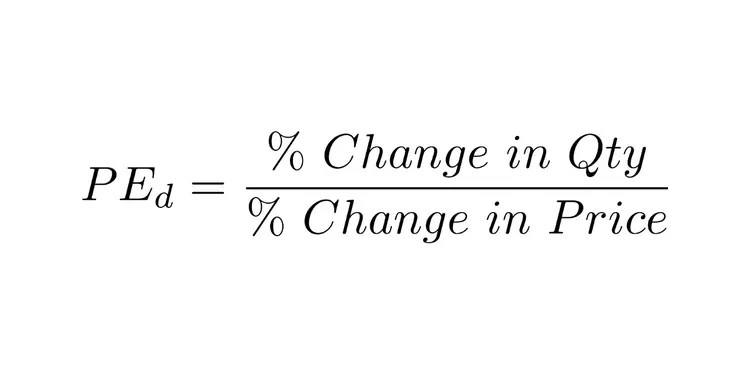
Elasticity is measured by the ratio of two percentages: the percentage change in quantity demanded divided by the percentage change in price.


if �/� is constant.[13][14] There does exist a nonlinear shape of demand curve along which the elasticity is constant: �=��1/�, where � is a shift constant and � is the elasticity.


Second, percentage changes are not symmetric; instead, the percentage change between any two values depends on which one is chosen as the starting value and which as the ending value. For example, suppose that when the price rises from $10 to $16, the quantity falls from 100 units to 80. This is a price increase of 60% and a quantity decline of 20%, an elasticity of (−20%)/(+60%)≈−0.33 for that part of the demand curve. If the price falls from $16 to $10 and the quantity rises from 80 units to 100, however, the price decline is 37.5% and the quantity gain is 25%, an elasticity of (+25%)/(−37.5%)=−0.67 for the same part of the curve. This is an example of the index number problem.[15][16]
Two refinements of the definition of elasticity are used to deal with these shortcomings of the basic elasticity formula: arc elasticity and point elasticity.
Arc elasticityEdit
Main article: arc elasticity
Arc elasticity was introduced very early on by Hugh Dalton. It is very similar to an ordinary elasticity problem, but it adds in the index number problem. Arc Elasticity is a second solution to the asymmetry problem of having an elasticity dependent on which of the two given points on a demand curve is chosen as the “original” point will and which as the “new” one is to compute the percentage change in P and Q relative to the average of the two prices and the average of the two quantities, rather than just the change relative to one point or the other. Loosely speaking, this gives an “average” elasticity for the section of the actual demand curve—i.e., the arc of the curve—between the two points. As a result, this measure is known as the arc elasticity, in this case with respect to the price of the good. The arc elasticity is defined mathematically as:[16][17][18]��=(�1+�22)(��1+��22)×Δ��Δ�=�1+�2��1+��2×Δ��Δ�
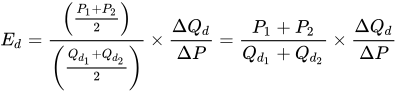
This method for computing the price elasticity is also known as the “midpoints formula”, because the average price and average quantity are the coordinates of the midpoint of the straight line between the two given points.[15][18] This formula is an application of the midpoint method. However, because this formula implicitly assumes the section of the demand curve between those points is linear, the greater the curvature of the actual demand curve is over that range, the worse this approximation of its elasticity will be.[17][19]
Point elasticityEdit
The point elasticity of demand method is used to determine change in demand within the same demand curve, basically a very small amount of change in demand is measured through point elasticity. One way to avoid the accuracy problem described above is to minimize the difference between the starting and ending prices and quantities. This is the approach taken in the definition of point elasticity, which uses differential calculus to calculate the elasticity for an infinitesimal change in price and quantity at any given point on the demand curve:[20]��=d��d����
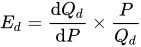


In other words, it is equal to the absolute value of the first derivative of quantity with respect to price d��d� multiplied by the point’s price (P) divided by its quantity (Qd).[21] However, the point elasticity can be computed only if the formula for the demand function, ��=�(�), is known so its derivative with respect to price, ���/��, can be determined.




In terms of partial-differential calculus, point elasticity of demand can be defined as follows:[22] let �(�,�) be the demand of goods �1,�2,…,�� as a function of parameters price and wealth, and let �ℓ(�,�) be the demand for good ℓ. The elasticity of demand for good �ℓ(�,�) with respect to price �� is��ℓ,��=∂�ℓ(�,�)∂��⋅���ℓ(�,�)=∂log�ℓ(�,�)∂log��


 BIBEK
BIBEK 
Thank you
LikeLike